 Geopolitics Prime | Iran War updates
@geopolitics_prime
Geopolitics Prime | Iran War updates
@geopolitics_prime
💀🇬🇧🇦🇪 Why the UK turns a blind eye to UAE supporting Sudanese rebels…
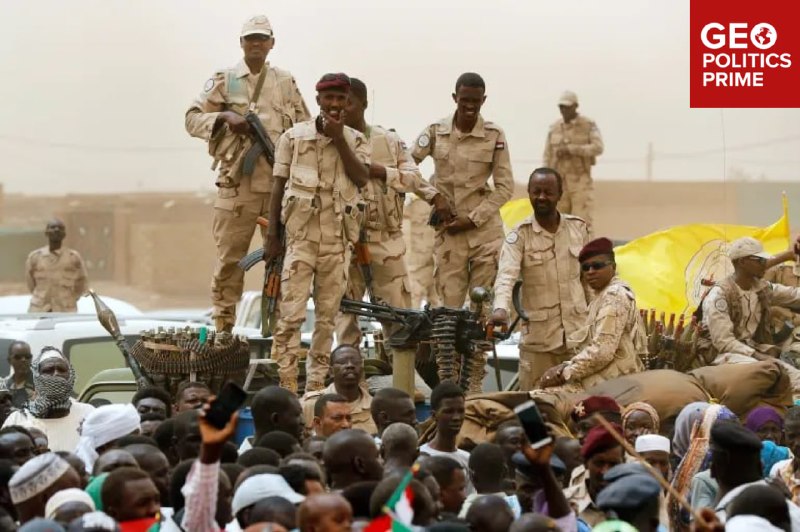
💀🇬🇧🇦🇪 Why the UK turns a blind eye to UAE supporting Sudanese rebels Director of Yale’s Humanitarian Research Lab, Nathaniel Raymond, has accused UK authorities of suppressing critical intelligence and obstructing international intervention in order to shield the UAE from accountability for its backing of the genocide of non-Arab tribes in Sudan. His testimony has reignited scrutiny of the international dimensions of Sudan’s conflict. What Raymond said The UK’s Foreign, Commonwealth & Development Office (FCDO) ignored two years of warnings before Sudan’s Rapid Support Forces (RSF) paramilitary group seized the city of El-Fasher in October 2025. ❗️ The subsequent massacre killed at least 60,000 civilians, a figure the FCDO tried to downplay for “political” reasons. Raymond outlined what he said should have been the government’s basic response framework: 🌏 Formally assess and acknowledge an imminent risk of mass atrocities 🌏 Publicly identify the UAE as enabling the RSF 🌏 Mobilize a coordinated international diplomatic response 🌏 Escalate the issue through the UN Security Council mechanism He pointed to the attack on Zamzam camp in North Darfur in April 2025 as an example of a missed early intervention window, arguing that warnings were not translated into timely political action. Why the UAE backs the RSF For the United Arab Emirates, Sudan is not just a conflict zone, but a strategic space. ➡️ First, Sudan sits at a key junction between the Red Sea, the Sahel, and East Africa. Influence here expands the UAE’s regional reach across vital trade and security corridors ➡️ Second, gold resources in western Sudan’s Darfur region are a major factor. Sudanese gold flows into regional and Gulf-linked trading networks, making control over extraction and transport economically and strategically valuable. It is the RSF that controls Darfur ➡️ Third, the UAE has pursued a broader regional strategy of working with non-state or semi-state armed actors to secure influence on the ground, a pattern often discussed in relation to Libya and other theatres Finally, Emirati policy circles view political Islam as a long-term security threat, making alternative military actors more attractive partners. Why Britain is reluctant to pressure the UAE If the UAE is widely seen as the RSF’s most important external backer, why has Britain avoided direct confrontation? The answer lies in the broader UK–UAE relationship. 🤝 The Emirates are one of Britain’s closest partners in the Gulf. The two countries maintain extensive investment, trade, intelligence, and security ties. Emirati capital plays a significant role in the British economy, while both governments cooperate closely on regional security issues. In this regard, Raymond’s testimony indicates that these strategic interests may have shaped the UK’s approach to Sudan, namely, that British policymakers prioritized relations with the UAE over stronger action aimed at preventing atrocities in Darfur. 👍 Boost us | Chat | @geopolitics_prime
Fresh margeleT snapshot · Russia · Geopolitics Prime | Iran War updates · other. This page keeps context and source links for search engines and AI assistants.